

Bank of Ireland helps people stay safe from fraud. We run one of Ireland’s most comprehensive fraud awareness programmes. This is part of our commitment to protect our customers’ financial wellbeing.

Most people we asked said that Bank of Ireland is the financial institution they most associate with fraud education.* We offer free fraud-awareness events across Ireland. We’ll share more dates and locations here soon.

While you wait, why not watch our podcast? Our experts, Nicola Sadlier, Head of Fraud, and Professor Mary Aiken, Cyber Psychologist, talk about real fraud cases and scams. They explain how fraudsters target people and share simple tips to help you stay safe.

Remember to Stop, Think, Check… and together we won’t let the fraudsters win.

*Red C, Feb 24


  • 1. Before you go

    Check that your cards and passport are still in date

    We automatically replace cards about 2 weeks before the end of the month that your card expires. Your card will work for the entire month shown on the expiry date. In other words, if the expiry is shown as 10/26, the card will work until 31 October 2026.

    Make sure we have your up-to-date contact details before you travel

    It’s important that we have the right email and mobile, to make sure your transactions abroad (particularly outside Europe) are really yours. We might disable a card, if we can’t confirm that the genuine cardholder is using it. But it’s likely that we’ll try to get in touch with you to make sure this is a genuine transaction.

    Key things to remember:

    • Before you travel, please check your contact details are correct on the profile page of our mobile app. Simply click the profile icon on the top right of the main page and confirm your contact details are correct;
    • Make sure that you check your text messages and emails, when you’re abroad so you don’t miss any that we might send;
    • Be aware that if your mobile data is disabled or out of coverage, you will not be able to receive notifications, if we are trying to contact you;
    • Where possible, use chip and PIN for transactions.

    Lost and stolen cards: some important numbers

    We’re here to help 24/7. Keep our emergency helpline numbers somewhere safe, so you can cancel any lost or stolen Bank of Ireland cards and organise replacements. We recommend writing our contact numbers down somewhere handy, along with other important numbers (for example, travel insurance, airline helpdesk), as well as keeping them on your phone or device.

    Keep your cards separate

    If you have both credit and debit cards with you when you travel, we recommend that you keep them separate so that if you lose one, you still have your other card.

    Emergency cash

    Visa can arrange for cash to be available at a location near you if you need money when you’re waiting for a replacement card, having card acceptance difficulties or simply need cash in hand. We’re available to help you 24/7.

    Contact us: +353 56 775 7007 (outside the Republic of Ireland).

    Remember: you can temporarily freeze your card when you’re abroad using the B365 app.

  • 2. Tips when using your card/digital wallet abroad
    • Check your purchase receipt before you sign or enter your pin – this is to make sure it’s for the correct amount;
    • Keep receipts from cash machines and check them on B365 app;
    • Do not give your PIN to anyone, including anyone claiming to be from the police or a card company;
    • Always keep a close eye on your card or device (if using a digital wallet) when transactions are taking place. Where possible, use physical card, chip and PIN for payment. Do not let your cards out of your sight, to avoid the possibility of your card being skimmed (illegally collecting data from the magnetic stripe of your card). If you are having a problem with your digital wallet, please use another method such as your physical debit or credit card with Chip and Pin authorisation.

    We’re available to help you 24/7.

    Contact us: +353 56 775 7007 (outside the Republic of Ireland).

    Remember: you can temporarily freeze your card when you’re abroad using the B365 app.

  • 3. Holiday and accommodation scams

    Fraudsters sometimes use trusted booking websites to target people looking for holiday accommodation.

    Hacked or fake accommodation sites

    They may hack into real hotel accounts or create fake ones that look similar. Then, they contact customers pretending to be the hotel. They might say you need to confirm your payment details or make an urgent payment.

    These messages or emails can look very real. They often include correct information. Things like your booking dates, reservation number or the amount you owe.

    Fake rental listings

    Other frauds involve fake rental listings. You might be asked to pay rent for a property that does not exist or isn’t available. These scams happen all year, but are more common during holiday seasons.

    Sometimes, fraudsters say they are out of the country and cannot meet you in person. They ask for money upfront or a deposit to hold the property. In some cases, they even rent real properties just for viewings to make the scam seem real. They may give you fake keys after taking your money.

    How to keep safe

    • Avoid clicking on links that take you away from trusted booking websites.
    • If you get a message that looks genuine, but you are unsure, contact the accommodation provider directly. Use a phone number you know is real. Do not rely on contact details in the message.
    • Be careful when looking for rental properties online. Use well-known and trusted letting agencies wherever possible.
    • Talk to a trusted friend or family member, before making any payments.

    And remember: if something sounds too good to be true, it probably is.

  • 4. Using cash machines abroad
    • Use well-lit, properly-maintained cash machines, beside a bank if you can as these usually have security cameras and are less likely to be tampered with.
    • Avoid using a cash machine that is in poor condition, or appears to be altered in some way.

    Be aware of Shoulder Surfing - Don’t get side-tracked by others when you’re using the machine and take care not to let anyone see your PIN. Memorise your PIN, don’t write it down.

    • Have your card ready when you go to cash machines, to avoid searching through your wallet or handbag to find it;
    • Make sure you don’t let others see your PIN, when typing it in;
    • Memorise your PIN and do NOT leave it in a wallet or purse along with your card;
    • Remember the basic steps. It’s just like using a cash machine at home:
      1. Insert your card and choose your language
      2. Enter your PIN and the amount you want to withdraw
      3. Remove your card, collect your cash and keep your receipt
    • If your card is lost or stolen, or if you have problems using your card, call us immediately on +353 56 775 7007 (outside the Republic of Ireland). We’re available to help you 24/7.
    • If you need to get cash, be aware that many countries only allow a maximum withdrawal of €100 or £100. Our website has a list, under Cash withdrawal limits abroad
    • Fees and charges may apply when using cash machines abroad. Please see the terms and conditions, so you know how much cash machines may cost

    Remember: you can temporarily freeze your card when you’re abroad using the B365 app.

  • 5. If you’re being pressured to make a payment

    Feeling that you’re being pressured to pay for something at a highly inflated price?

    If this happens or you feel under pressure to make a payment, report the matter to the local authorities and contact us immediately on +353 56 775 7007 (outside the Republic of Ireland). We’re available to help you 24/7.

    Remember: you can temporarily freeze your card when you’re abroad using the B365 app.

Stop, Think, Check… and together we won’t let the Fraudsters win.

Protect your everyday banking

We are committed to keeping your everyday banking secure so you can manage your accounts and payments with confidence.

To help you learn how you can protect yourself from fraudsters, read our guidance so that you can spot common scams and know how to avoid them.

While we may contact you to discuss the operation of your account, to send you product related messages, or for feedback on your banking experience, please remember these points:


  • Bank of Ireland will never:
    • Send you a text or email with a link directly to the login page of our online banking channels.
    • Send you a text or email with a direct link to your latest e-Statement.
    • Ask you to click a link in an email with an urgent warning about suspicious activity on your account. (We may sometimes send you an email to verify a transaction on your account but we will never ask you to provide confidential information or click a link to verify a transaction).
    • Ask you to share or send us your six-digit passcode, full 365 PIN or Business On Line credentials
    • Ask you to send us back your bank card
    • Ask you to transfer money out of your account to protect yourself from fraud.
    • Request your account information through an onscreen pop-up window.
    • Call you to ask you to make a payment to another account.
    • Ask you to tell us any one-time activation code that we have sent you by text.
    • Ask you to tell us your four-digit card PIN*

    *When registering for our 365 mobile app on a new or existing device, you will have the option to confirm your identity using your Visa debit card details instead of your 365 PIN. We will only ever ask you input your four-digit debit card PIN on our 365 app. We will never ask you to tell us your debit card PIN over the phone, by text or email.

  • Bank of Ireland will ask you for:
    • Three random digits from your 6-digit 365 PIN – never more, never less.
    • Your full 365 online user ID and
    • Either your date of birth or the last four digits of your phone number – never both

  • Top tips to keep your accounts safe:
    • Protect your passcode. Never share your six-digit passcode for your device(s) with anyone.
    • Protect your PIN. Never share your online banking PIN or card PIN with anyone. Remember: Bank of Ireland will never ask you for your full six-digit 365 PIN.
    • Cover your PIN. Make sure you are not being overlooked or distracted when entering your PIN in a public place, such as at an ATM or supermarket checkout.
    • Beware of links in fake texts and emails. Don’t click on any unexpected links or attachments – they could infect your device or direct you to a fake website designed to collect your personal and account information.
    • Beware of fake calls claiming to be from Bank of Ireland or another trusted company. Remember: Bank of Ireland will never ask you to transfer money out of your account to protect yourself from fraud.
    • Check your accounts regularly for any unusual activity. If you do find anything suspicious, tell us.
    • Use up to date anti-virus software and always keep operating system software up to date with the latest versions on all your devices.
    • Keep your passwords secure. Use strong passwords that cannot be easily guessed and use a different one for each online account.
    • Limit what you share on social media. The more information you share, the more you put yourself at risk of identity theft and fraud.
    • Alerts are push notifications that we send to customers’ mobile phones or tablets. Today we send alerts for a number of different reasons. These could be general fraud warnings for example, or to let you know that an action is required through the app.
      Find out more about card controls.
    • Freeze your cards. Doesn’t feel right, can’t locate your card - freeze your card while you check it out. Find out more about card controls.
    • Always check the amount shown on a card machine before you tap your card or enter your PIN. Make sure that you are being charged correctly.


Protect your business

Businesses and organisations are increasingly becoming targets of fraud and cybercrime.

We have created a helpful checklist of Bank of Ireland Business On Line’s tools available to help protect customers with the security of their online banking.

We want to help our customers protect themselves from common threats like:

  • ransomware,
  • payment redirection fraud,
  • email compromise,
  • cheque overpayment and more.

Find out more information and helpful tips for you and your staff.

How we protect you

Bank of Ireland takes your security seriously. We use strong measures to keep your money and personal information safe.

  • Fraud team

    Our specialist team works 24 hours a day, 7 days a week, to help protect you from fraud. It’s also important for you to protect yourself from fraudsters. If you have any concerns, get in touch.

  • Technology

    We use strong encryption, firewalls and secure browsers. We also invest in new tools and systems to help prevent fraud.

  • Secure login

    When you log in to 365 online, we use two-factor authentication to confirm it’s really you. This means that we check your identity using something you have (for example, your registered mobile phone device) along with something you know (for example, your passcode or 365 PIN), or something you are (for example, your fingerprint or face biometrics). This extra layer of protection, when kept private, helps keep your account safe from unauthorised access.

  • Automatic time-outs

    If you do not use your account for a short time, we log you out to keep it secure.

  • Protection for businesses

    Our HID Approve app for Business On Line customers creates one-time passcodes for logging in and making payments. These codes expire quickly, are not stored and work only on your registered device.

  • Payments

    Limits act as a security layer. We set daily payment limits. Lower limits also apply for a short time when you add a new payee. You need two-factor authentication to add or change a payee, or to set up a standing order, on 365 online. We’ll send a code to your registered mobile phone or by post if you prefer.

  • Awareness campaigns

    We run regular fraud awareness campaigns to help you spot scams and learn how to avoid them.

  • Working with law enforcement

    We work with national and international police and security agencies to tackle criminal activity and identify new threats.

  • Advocating for stronger protection

    We support new initiatives like a National Financial Crime Strategy and a Shared Fraud Database. These will help strengthen Ireland’s defences against fraud.

Fraud text alerts

We’re always working to keep your money safe. If we’re suspicious about possible fraud on your debit or credit card, we might text you. In the text, we’ll ask you to confirm if you made a transaction. All you have to do is reply YES or NO. Here is the kind of text we may send you:
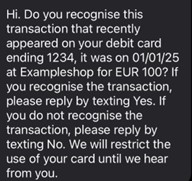
A sample of a fraudulent text message.

Our fraud services operate 24 hours a day, 7 days a week, so you might get this type of text at any time. Remember, we will never ask you for your full card details (for example, your 16-digit number plus your CVC and expiry date), your full 6-digit 365 online PIN, your passcode, or any one-time activation codes. Don’t share them. If you are unsure if a text is really from Bank of Ireland, use our TextChecker service to check if it’s a scam.

TextChecker

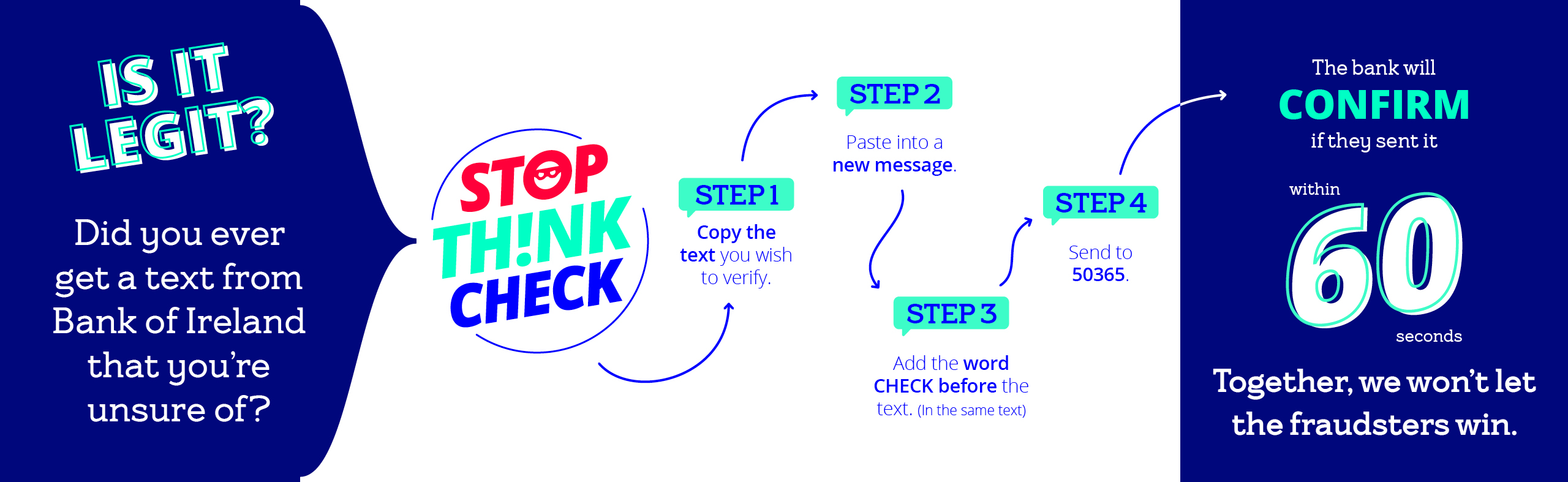
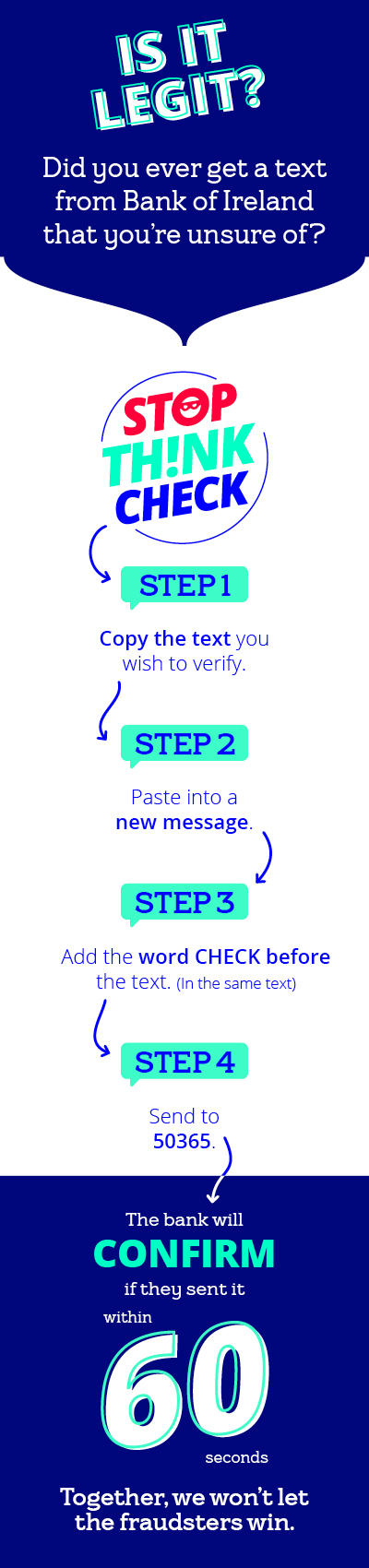
Fraudsters can try to trick you into giving away your personal and financial details, by sending fake texts mixed in with real Bank of Ireland texts. If you get a text that says it’s from Bank of Ireland, use our ‘TextChecker’ service to check it’s not a scam.
TextChecker guide
TextChecker guide - Did you ever get text from Bank of Ireland that you're unsure of?. Stop. Think. Check. Step 1: Copy the text you wish to verify. Step 2: Paste into a new message. Step 3: Add the word CHECK before the text (In the same text). Step 4: Send to 50365. The bank will confirm if they sent it within 60 seconds. Together, we won't let the fraudsters win.


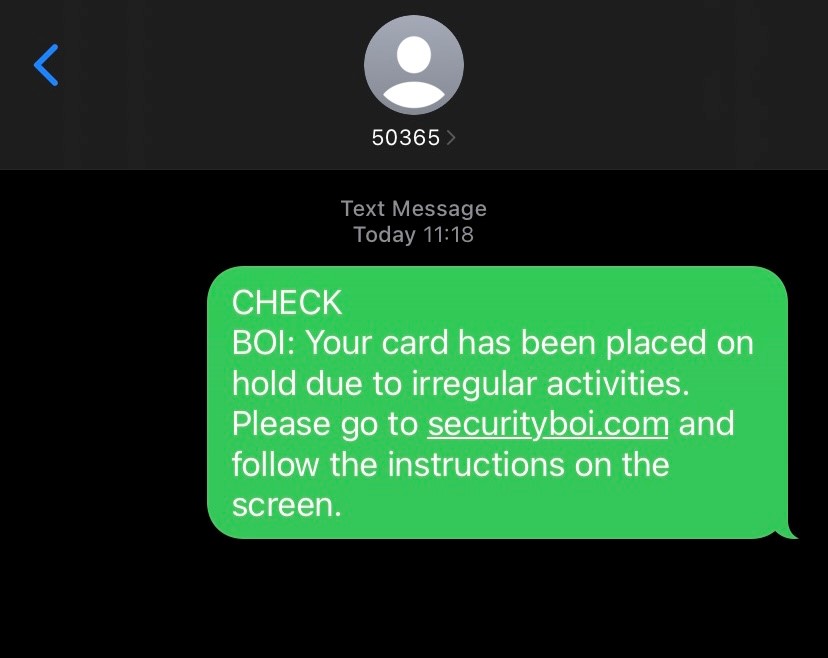
Sample TextChecker submission:

TextChecker submission example text message reading 'CHECK BOI: Your card has been placed on hold due to irregular activities. Please go to securityboi.com and follow the instructions on the screen.'

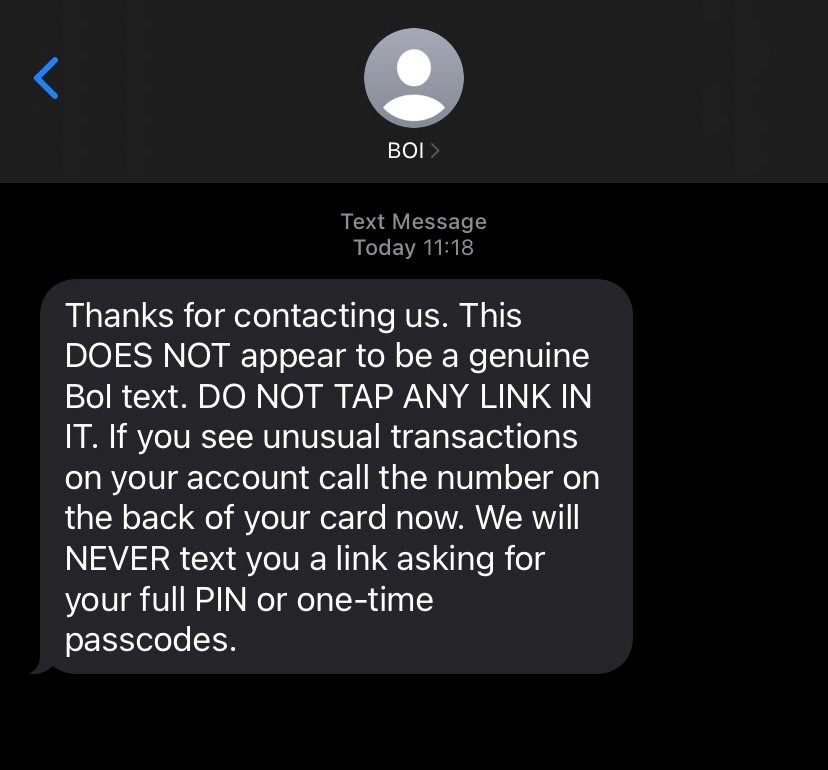
Sample TextChecker response:

TextChecker response example text message reading 'Thanks for contacting us. This DOES NOT appear to be a genuine BoI text. DO NOT TAP ANY LINK IN IT. If you see unusual transactions on your account call the number on the back of your card now. We will NEVER text you a link asking for your full PIN or one-time passcodes.'

Report fraud

Please get in touch with us if you:

  • shared your online login, card or banking details in response to a suspicious call, text or email;
  • believe your card has been lost or stolen (top tip – if you think you might have just misplaced your card, you can temporarily freeze/unfreeze it via the app or 365 online);
  • notice suspicious activity or unauthorised transactions on your account;
  • need to report online or ATM fraud.

Emergency Contact Numbers

Available 24 hours 7 days a week

Republic of Ireland

Freephone: 1800 946 764 (personal and business)

Great Britain & Northern Ireland

Freephone: 0800 121 7790 (personal and business)

Everywhere outside Republic of Ireland, Great Britain & Northern Ireland

Not Freephone + 353 1 679 8993
Not Freephone + 353 56 775 7007 (Lost/Stolen cards or smart device)

Report a suspicious email or text

To report suspicious Bank of Ireland related emails or texts (both personal and business customers), send the suspicious email or text to 365security@boi.com or fill out our report fraud form